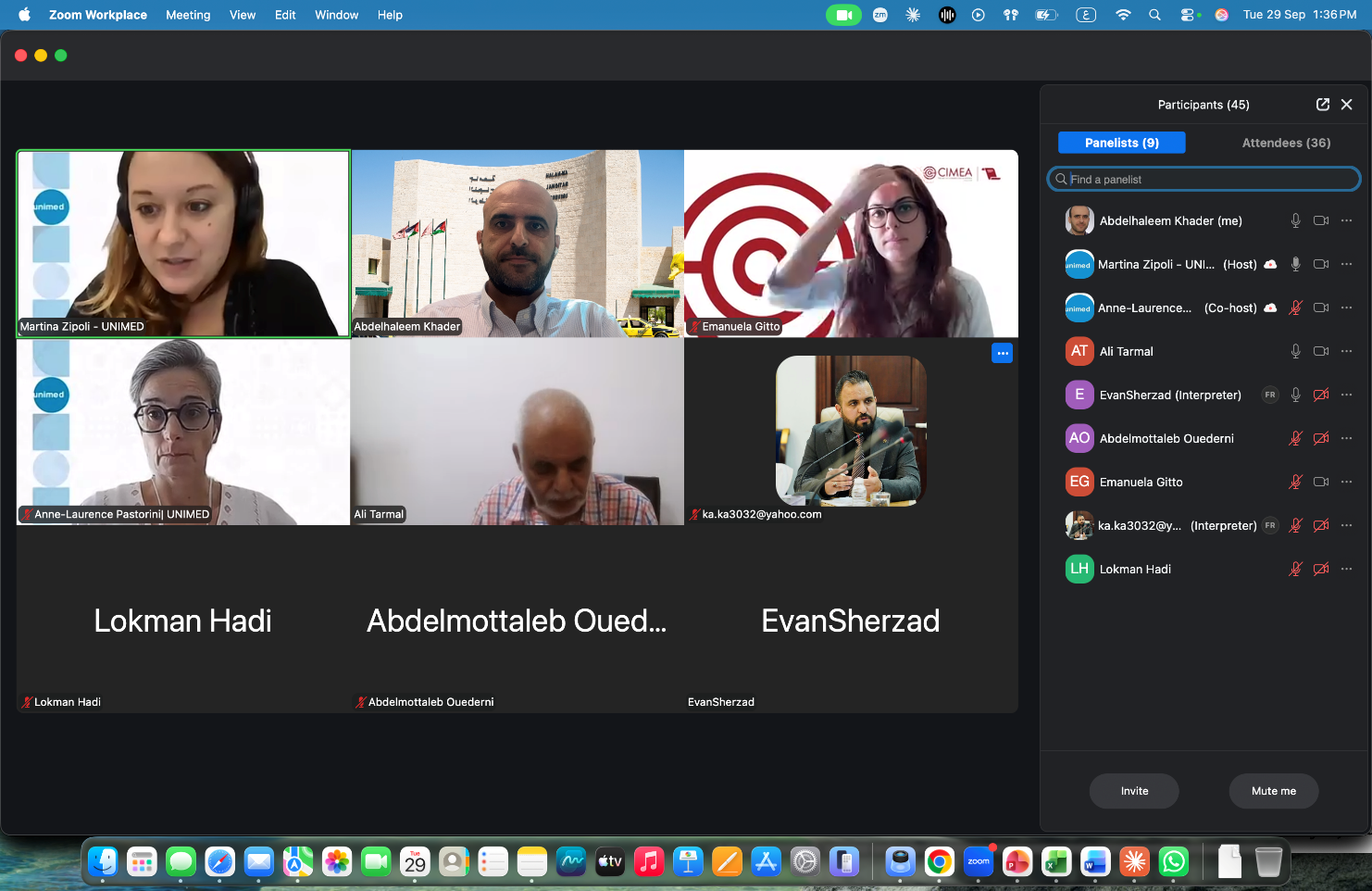
BASE coordinator takes part in the ARMONIA benchmarking webinar on Bologna Process implementation in the Mediterranean
Nablus / Online — 29 September 2026
Dr. Abdelhaleem Khader, Assistant Dean of Scientific Research at An-Najah National University and coordinator of the BASE project, presented the Palestinian experience of Bologna Process adoption at a benchmarking webinar organised by the Mediterranean Universities Union (UNIMED) on 29 September 2026.
The webinar was held within ARMONIA, a project that supports the harmonisation and modernisation of the Libyan higher education system through the introduction of Bologna Process principles and practices. ARMONIA brings together thirteen Libyan universities and the Ministry of Higher Education and Scientific Research in Libya. The session was designed as an exchange rather than a lecture: alongside the Palestinian case, it featured the Tunisian experience, the experience of the Kurdistan Region of Iraq, an opening by UNIMED Director Marcello Scalisi, an overview of Bologna implementation in Libya by the Ministry, and a keynote on Bologna fundamentals by CIMEA. The webinar was conducted in English with Arabic interpretation; Dr. Khader delivered his intervention in Arabic.
Speaking on behalf of An-Najah, Dr. Khader traced the university's path in two stages — the ground prepared before BASE, and the transition carried out through it. He described the drivers that set the reform in motion, among them outcomes-based international programme accreditation, the maturing of internal quality assurance, and the recurring difficulty of explaining the value of a Palestinian credit hour to partners abroad. He then set out what changed in practice: the shift from counting teaching hours to measuring student workload in ECTS, the redefinition of a degree through programme and module learning outcomes, the alignment of teaching methods and assessment to those outcomes, and the involvement of employers, students and the national accreditation commission in programme design from the outset.
The intervention was deliberately candid about difficulty. Dr. Khader identified the honest recalculation of student workload as the hardest single step, and noted that resistance within faculties was rarely ideological — it concerned workload, ownership and time, and therefore had to be answered with resources rather than argument. He was equally direct about what remains unresolved: the coexistence of ECTS-based and credit-hour programmes within the same institution, national regulation that is still catching up with practice, and the fact that the real test of student-centred teaching begins only now, as the first cohorts enter the new programmes.
“The move to Bologna is not a reformatting of study plans. It is a change in the unit of measurement — from the hours we teach to the work a student actually does. Everything else follows from that,” Dr. Khader told participants.
Closing with recommendations for colleagues in Libya, where several universities have moved ahead of the national framework, he advised starting with one programme designed properly rather than with a general policy, seating the accreditation body at the table from the first month, calculating student workload honestly, drafting the national rule while piloting rather than afterwards, and budgeting for teaching staff and not only for curriculum design — “accreditation is the starting line, not the finish.”
The organisers welcomed the relevance of the Palestinian case to the Libyan context, and both sides expressed interest in continuing the exchange. An-Najah remains open to direct contact with Libyan universities working on workload calculation, accreditation requirements and the management of two parallel credit systems.
About BASE
BASE — Bologna for Science Education in Palestine and Jordan — is an Erasmus+ capacity-building project (project no. 101177752) coordinated by An-Najah National University and running from November 2024 to October 2027. It brings together universities, ministries, national accreditation and quality assurance bodies, European academic institutions and regional organisations in Palestine, Jordan and Europe. The project has designed seven new Bologna-aligned bachelor programmes in the sciences, all of which have passed national accreditation; teaching under the new programmes began this academic year. BASE was awarded the Union for the Mediterranean label in October 2025 and was shortlisted for the Times Higher Education Arab World Awards 2026 in the category of Teaching and Learning Strategy of the Year.